Key Information
Health Concerns
Talk to your healthcare provider before your appointment if you have any of the following:
- A known allergy to the iodine or any substance containing iodine, including contrast material used in CT exams.
- Diabetes, especially if you take metformin (Glucophage®).
- A history of kidney problems or diabetes. Blood work may be required to make sure your kidneys are functioning properly.
- A chance of being pregnant.
Pregnancy/Breastfeeding
Let your healthcare provider know if you are pregnant or breastfeeding.
CT exams can be performed during pregnancy, though precautions must be taken to protect you and your baby.
If you are breastfeeding and require iodinated contrast for your CT exam, it is generally safe to continue breastfeeding immediately. A small amount of contrast may be found in the breast milk right after the exam, but the amount decreases by half in 2 hours and most, if not all traces of contrast is gone after 12 hours.
If you prefer to be extra cautious, you may express and discard breast milk for 24 hours after your exam. During this time, you can feed your baby with stored breast milk or formula. After 24 hours, you can safely resume breastfeeding.
The decision to proceed with exam is always yours. We encourage you to discuss the benefits and risks with your healthcare provider so you can make an informed choice that feels right for you.
CT Visit: Step by Step
Before
You will receive an automated reminder notifications via SMS prior to your scheduled appointment – please confirm or cancel.
To reschedule, please call our booking office at least 48 hours in advance at 905-787-5700 ext. 1094. Your prompt notice helps us serve everyone better, as imaging appointments are in high demand.
Be sure to follow appropriate preparation instructions for your upcoming exam.
Please let us know if you need language support, translation or accessibility assistance. We provide interpretation and translation services to ensure you have all the information you need before your appointment.Schroeder Ambulatory Centre is a scent-free environment.
Examination
When you arrive at Schroder Ambulatory Center, please check in at the Registration Desk A near the Leslie Street entrance.
You will change into a patient gown to ensure your clothing doesn’t interfere with the scan. Please remove metal items such as jewelry, belts or hair pins.
During your exam, you may receive an oral or intravenous (IV) contrast dye to help highlight specific anatomical structures. This will provide the Radiologist with more information for an accurate assessment.
Exams typically take 5 to 30 minutes, depending on the type of exam.
Aftercare
If you received IV contrast, drink plenty of water. Otherwise, no special post-care is needed, unless informed otherwise by the technologist.
Exam Results
After your CT exam is completed, your images are reviewed and reported by a radiologist—a physician who specializes in interpreting diagnostic images. Technologists cannot provide scan results or diagnoses at the time of your exam.
Please note that your report may take up to five (5) business days to become available, although it is often available sooner.
You can access your results in two ways:
- Patient Portal – Sign up to access your diagnostic imaging report once it becomes available.
- PocketHealth – Sign up to access both your diagnostic images and report.
Reports on the Patient Portal become available approximately 24 hours after the radiologist’s report has been finalized. Images and reports on PocketHealth also become available approximately 24 hours after the radiologist’s report has been finalized.
Your report will also be faxed to your referring healthcare provider as soon as it has been finalized.
If you would like access to the Patient Portal or PocketHealth, please speak with one of our staff members for assistance with registration.
Radiation Safety FAQs
What is contrast material, and is it safe?
Contrast agents are sometimes used in CT scans to make blood vessels and soft tissues easier to see. They can be given orally or through an IV and are naturally eliminated from your body through urine or bowel movements.
Contrast is generally safe. You may feel a brief warm sensation, metallic taste, or urge to urinate during contrast injection. Mild allergic reactions (itching, rash, or hives) are rare, and severe reactions (throat swelling and difficulty breathing) are very rare. Most reactions happen during your visit, and our staff are trained to respond. If symptoms occur after leaving, seek care at the nearest emergency department.
What if I am pregnant?
If you are pregnant or think you might be, please inform the technologist before your exam. Your safety and your baby’s safety are our top priorities.
The technologist will follow strict safety protocols to keep radiation exposure as low as possible. According to Canadian Association of Medical Radiation Technologists (CAMRT) guidelines, routine fetal shielding is not required, as modern imaging equipment uses very low radiation and shielding may interfere with imaging and increase the need for repeat scans.
Iodinated contrast is not known to pose significant risk during pregnancy; however, if contrast is recommended, you may speak with the radiologist to discuss the benefits and risks before proceeding.
I’ve had several scans already, should I be worried?
It’s understandable to have concerns, but even if you’ve had several imaging exams, your overall radiation exposure is still very low.
Each scan is carefully justified by your healthcare team to ensure it’s medically necessary and provides valuable information for your care. Modern scanners automatically adjust the dose to your body and the type of exam, keeping your exposure as low as reasonably achievable while maintaining excellent image quality.
Why have shielding guidelines changed?
You may notice that lead aprons are no longer routinely used during X-ray or CT exams.
This change is based on the latest research showing that modern imaging equipment uses very low doses of radiation and targets only the area being scanned.
In fact, using shielding can sometimes block important parts of the image or cause the scanner to use more radiation to get a clear picture.
Rest assured, your safety is our top priority – today’s technology and careful dose management keep your exposure as low as possible while ensuring the best image quality for your care.
What if I still want to be shielded?
Every member of the Diagnostic Imaging team is committed to keeping you informed and supported throughout your visit. Your technologist will be happy to answer any questions you may have. If it helps you feel more comfortable, lead shielding may be requested when appropriate, as long as it does not block the area being imaged or affect image quality.
Why are staff continuing to wear shielding?
You may notice technologists and other healthcare staff wearing lead aprons or standing behind protective barriers. This is to protect them from repeated exposure to X-rays and CT scans over time – to reduce long-term, cumulative exposure. Unlike patients, staff are exposed daily, so these precautions help keep them safe. All patient care and staff practices follow strict radiation safety standards and advanced dose-reduction protocols to ensure safety.
About CT Scans
What is Computed Tomography?
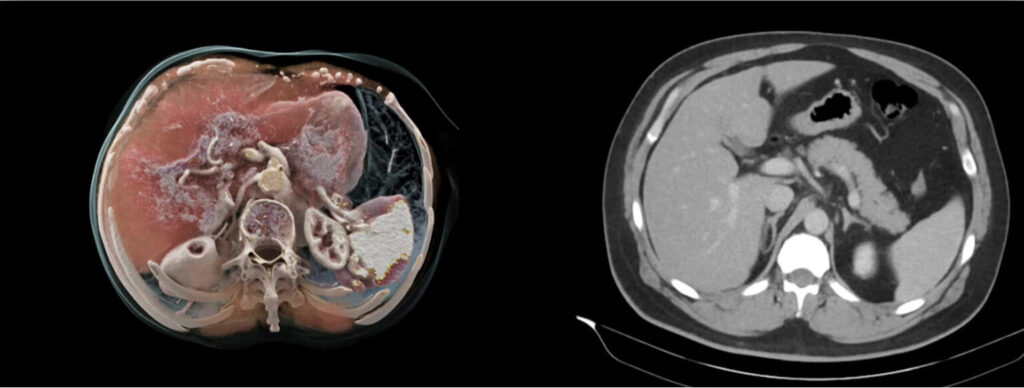
Computed Tomography (CT) is a safe, fast, and non-invasive test that provides detailed images of your body. Using a small amount of X-rays and advanced computer technology, it creates clear pictures of your bones, organs, blood vessels, and soft tissues.
CT scans are often used to help diagnose a wide range of conditions such as injuries, infections, or other diseases, and to guide your care or treatment. Most scans take only a few minutes to complete, though some may take up to about 30 minutes depending on the type of exam. You’ll be asked to lie still on a table that moves through the scanner, and the technologist will communicate with you throughout the process to ensure you’re comfortable and informed every step of the way.
Benefits/risks
CT scans create detailed images of your body to help your doctor diagnose and plan treatment. While some people worry about radiation, the exposure from a CT scan is minimal, and the risk is extremely low. There’s no conclusive evidence that the small amount of radiation from a CT scan causes cancer.
When your doctor recommends a CT scan, the expected benefits outweigh the small risk from radiation. You are encouraged to discuss the risks and benefits with your doctor or radiologist, and to ask if alternative imaging options may be suitable for your condition.
Today’s CT scanners are smarter than ever! They use advanced technology to keep radiation doses low — often similar to a few months of natural background radiation — while producing sharp, clear images to help your doctor make informed decisions.